
When a vehicle collision destroyed the Georgia Department of Labor's monument sign in downtown Atlanta, Signs and More, Inc. rebuilt it to match the original design. A year later, a second collision hit that rebuild — the same freestanding sign, in the same spot. This time, instead of building an identical sign a third time, we brought the client two options, engineered a different solution, and built a wall-mounted sign designed to hold up where the freestanding version couldn't. Signs and More managed every stage of this project as the client's single point of contact: inspection, engineering, permitting, fabrication, and installation. We brought in trusted partners we work with regularly for parts of the scope, but the client never had to track down or coordinate a single one of them; that responsibility stayed with us.
Signs and More, Inc. serves Metro Atlanta and North Georgia. This is a concrete record of how we handled a second monument sign collision at the same site, and what it shows about our ability to adapt a solution when a fix that worked once doesn't hold twice.
Why the second crash called for a different solution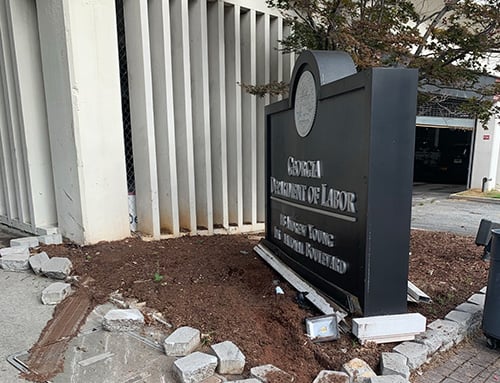
The Georgia Department of Labor's downtown Atlanta monument sign has been hit by a vehicle collision on two separate occasions, about a year apart. The first crash spun the sign around on impact: the 4" retainer at the bottom was bent, the 4" stucco base was broken and bent, the support post was bent, two letters were knocked loose, the 1/8" aluminum cabinet face needed evaluation for replacement, and the cabinet itself was scratched and needed repainting. We removed the sign, rebuilt it to match the original freestanding design, reused the letters and seal that survived, fabricated the two that didn't, and reinstalled it in the same spot.
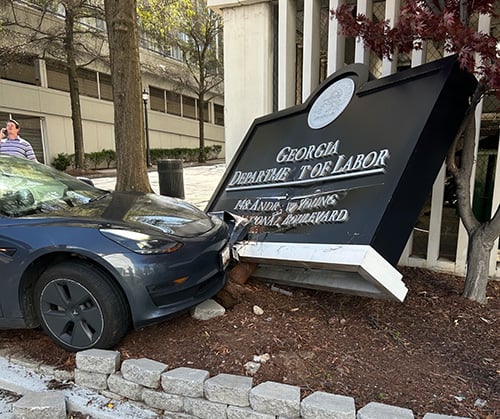
The second collision hit that rebuild sign in the same spot and compromised its structural integrity the same way the first one had. Once a monument sign's base and frame have taken a hit like that, the same rule applies as it does to a car: once the integrity is compromised, rebuilding the damaged structure isn't a safe option; only replacing it is. That's what made this second crash different: rebuilding the same freestanding design a second time in the same spot wouldn't have been a real fix, just a wait for a third crash.
That rebuild put the sign back exactly where it started — freestanding, at ground level, in the same spot exposed to the same traffic pattern that had already caused one collision. When a second vehicle hit it, we didn't recommend rebuilding it the same way a third time. We told the client plainly: the freestanding design in that location had already failed twice, and an identical rebuild would just be waiting on a third crash. This is the second time we've had to rebuild this sign for the Georgia Department of Labor, and an identical rebuild would have made it the third monument sign standing at that same spot.
Two options, one recommendation: giving the client a real choice
After the second crash, we brought the Georgia Department of Labor two options instead of one:
- Rebuild it as before — a new freestanding aluminum monument sign with a stucco base, matching the original design exactly, the same solution we'd used after the first crash.
- Change the design entirely — move away from a freestanding structure at ground level and mount the sign to the wall instead, out of the path of vehicle traffic.
A similar wall-mounted sign at a nearby Emory University property gave us the idea for this approach — a ground-level sign in a location that put it at risk, solved by moving it onto the building instead. That's part of why we could recommend it here with confidence, not as an untested idea.
The Georgia Department of Labor chose the second option. Fool us once with a repairable design in a vulnerable spot — fool us twice, and it's on us not to have proposed something different. This time, we did.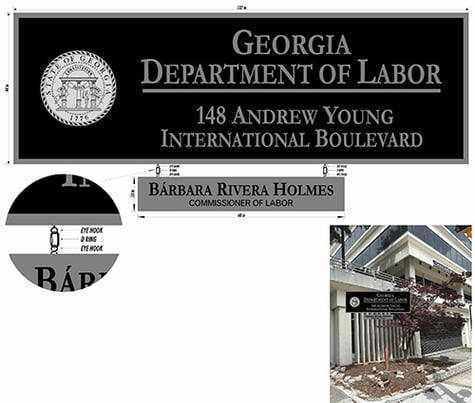
What structural sign engineering meant for this project
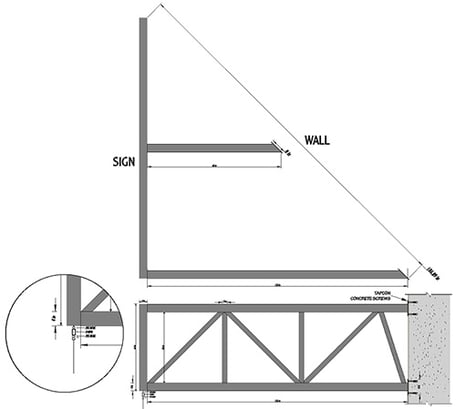
Structural sign engineering is what made the wall-mounted redesign possible without simply guessing that it would hold. For this rebuild, we designed a 44" x 132" x 5" aluminum monument sign, fabricated new from the ground up, attached to the building wall with brackets engineered specifically for that assembly. A 10" x 60" panel below the main sign carries the commissioner's name in vinyl.
Because the sign was now wall-mounted rather than ground-mounted, the engineering problem changed entirely: instead of calculating foundation loads and soil conditions, our engineers had to certify that the bracket assembly could safely carry the sign's weight and wind load at a 45 degree angle to the building's face. We prepared professional engineer certified drawings for that bracket assembly, which is what let the permitting department approve a design that didn't exist as a standard product — it was built specifically for this wall, this sign, and this client's history with the location.
What we did: from damage assessment to final installation
For this rebuild, the wrecked freestanding sign wasn't salvageable, so we fabricated the new wall-mounted sign entirely from reused letters and seal. A fresh aluminum sign face and engineered brackets built specifically for the wall mount.
Here's the sequence we followed on this rebuild:
- On-site inspection of the crash damage to the sign structure, base, and face
- Damage evaluation to confirm what could be reused and waht needed to be built from scratch.
- Structural sign engineering — bracket assembly certification for the wall-mounted redesign
- Permit coordination with the relevant Atlanta-area jurisdiction before any work began
- Fabrication and installation, with final inspection and sign activation
- Road closure permit to allow proper access to wall for mounting.
Because Signs and More stayed the single point of contact across both rebuilds, there was no gap between what the engineer designed and what got built on site. That continuity is also what let us recognize, after the second crash, that repeating the first solution wasn't the right call, and to have a proven alternative ready to propose.
Why property managers choose Signs and More for structural sign work
We bring over 125 years of combined team experience to projects like this Georgia Department of Labor rebuild — experience that's why our crews could recognize, after a second collision, that a different design was the right call and had a proven precedent ready to offer.
Because design, permitting, fabrication, and installation are all managed through Signs and More as a single point of contact, there's no finger-pointing and no gap between what was engineered and what got built. That accountability, and the willingness to adapt a solution to a client's actual situation instead of repeating a fix that already failed, is what you're paying for on a monument sign replacement or commercial sign repair project.