
Why Do Commercial Signs Fade, Turn Yellow, and Look Burnt?
You walk past your building sign every day, so it can be hard to notice when it starts going downhill. Then one morning the light hits it differently and you see it — the face is yellow, the cabinet looks chalky, or the whole thing has this strange, scorched appearance. No, it did not catch fire. But it has been fighting a slow battle it was never going to win on its own.
UV radiation is relentless, especially in Georgia. Studies show that exterior plastics can lose up to 50 percent of their tensile strength after just a few years of direct sun exposure. For a sign face, that degradation does not just affect strength — it shows up in the way your sign looks every single day.
The Short Answer: Signs fade, yellow, chalk, and blister primarily because of UV exposure, heat from internal lighting, oxidation of metal components, and moisture infiltration. Sign refurbishment in Atlanta and north Georgia is often a cost-effective fix — new acrylic faces, a repainted cabinet, and updated graphics can restore a sign to like-new condition without full replacement. Signs and More is a full-service sign company serving commercial businesses across metro Atlanta and north Georgia, handling assessment, manufacturing, and installation in-house.
Why Do Commercial Signs Fade, Yellow, and Deteriorate?
The damage does not come from one place. Several forces are working on your sign at the same time:
- UV degradation — ultraviolet light breaks down acrylic and polycarbonate sign faces, causing yellowing and loss of clarity; Georgia's long sun season accelerates this more than most northern markets
- Paint chalking — the resin in aluminum cabinet paint oxidizes over time, leaving a powdery white residue on the surface
- Metal oxidation — aluminum and steel components develop a dull, bronzed, or pitted layer when exposed to moisture and air
- Heat damage — internal lamps run hot, and over years acrylic faces can warp or develop scorched-looking discoloration near lamp positions
- Moisture infiltration — degraded seals let water in, which accelerates every other form of damage
- Age — all sign materials eventually reach the end of their useful service life
- Poor quality sign materials —
Age and Expected Service Life
Every exterior sign has a lifespan. Even when a sign is properly manufactured and maintained, decades of sunlight, temperature swings, moisture, and daily operation eventually take a toll on the materials.
A high-quality cabinet sign built with premium materials may remain structurally sound for 15 to 25 years or longer, but the cosmetic components often require attention much sooner. Faces, graphics, paints, and protective coatings are typically the first elements to show their age.
The question is not whether a sign will eventually deteriorate — it is whether the materials used during manufacturing allow it to age gracefully or fail prematurely.
Back-Painted Lexan vs. Vinyled Acrylic
One of the biggest factors affecting sign longevity is how the graphics were originally produced.
The best, longest lasting method for producing translucent signage is using back-painted Lexan (polycarbonate) faces. The clear polycarbonate face protects the second surface graphics. This method has been used for decades, and you can see some very old faces beginning to fade, discolor, crack, or peel as the paint system ages. Once deterioration starts, repairs can be difficult because the graphics are permanently painted onto the material.
Modern sign faces are frequently produced using translucent vinyl applied to acrylic faces. Premium translucent vinyl systems provide consistent color, easier replacement, and good long-term appearance when properly fabricated. Due to the direct exposure to the elements, these faces do not last as long as back-painted faces.
However, not all vinyl graphics are created equal. The quality of the vinyl and the protection applied over it can dramatically affect how long a sign maintains its appearance.
The Hidden Problem: Graphic Protection Matters
Many sign failures begin long before the customer notices them. The difference often comes down to whether the graphics were properly protected during manufacturing.
No Laminate
Some manufacturers apply printed graphics directly to the sign face without any protective laminate. This reduces production costs but leaves the printed inks completely exposed to UV radiation, moisture, pollutants, and daily weather exposure.
The result is predictable: accelerated fading, color shifting, ink breakdown, and premature graphic failure. In Georgia's climate, unprotected graphics can begin showing noticeable deterioration far sooner than properly laminated graphics.
Cheap Laminate
Simply having a laminate does not mean the sign is protected.
Lower-quality laminates are often selected because they cost less upfront, but many yellow, shrink, crack, become brittle, or lose adhesion after years of sun exposure. In some cases, the laminate itself becomes the failure point, creating cloudy, hazy, or distorted graphics even when the underlying sign face remains structurally sound.
A cheap laminate can shorten the useful life of an otherwise well-manufactured sign.
Liquid Laminate
Liquid laminates are frequently marketed as a cost-effective alternative to premium film laminates. While they may provide short-term protection, they generally cannot match the UV resistance, durability, thickness, or long-term performance of a high-quality cast overlaminate.
Over time, graphics protected only by liquid laminate often experience faster fading, chalking, and surface deterioration than graphics protected by premium laminated film systems.
For long-term exterior performance, premium UV-resistant vinyl paired with a high-quality protective overlaminate remains one of the most effective defenses against Georgia's intense sunlight and weather conditions.
Material quality at the time of manufacture makes a significant difference. Signs built with UV-resistant acrylic, commercial-grade aluminum, 3M-certified vinyl, and industrial-grade coatings resist these forces far longer than signs built to lower specifications. When a sign fails early, it is almost always a materials or installation issue — not inevitable wear.
What Does a Deteriorating Sign Actually Look Like?
You may not have the vocabulary for it, but you know it when you see it:
- yellowing or amber tinting on white or light-colored acrylic faces
- a dull, hazy film that makes colors look washed out
- chalky, white powder coating on painted aluminum cabinets
- bubbling, blistering, or peeling on graphics or painted surfaces
- dark, scorched-looking rings near the lamps inside an illuminated sign
- bronze or brownish oxidation on metal trim and frames
- cracking or crazing on the surface of acrylic panels
If any of those sound familiar, your sign is telling you something.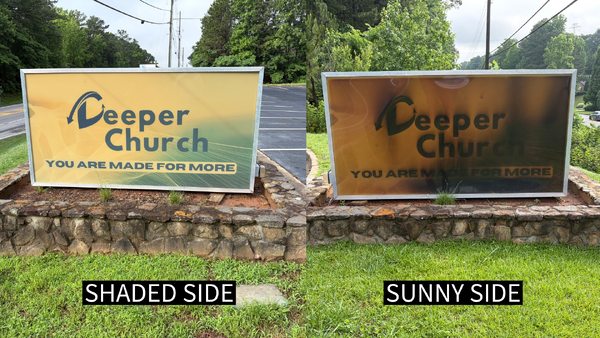
Why It Matters More Than You Might Think
Your sign is often the first physical impression someone has of your business. A faded or damaged sign signals that maintenance is not a priority — and for commercial tenants, property managers, government facilities, or multi-site businesses, that quietly undermines the credibility you have spent years building.
There is a practical issue too. Yellowed acrylic cuts down on light transmission. You are paying to run lights through a face that is blocking much of what they produce.
Can a Faded Sign Be Refurbished? What Sign Refurbishment in Atlanta Typically Covers
Not every damaged sign needs to be fully replaced. A targeted refurbishment can restore a sign to like-new condition at a fraction of replacement cost.
What can typically be refurbished:
- acrylic faces — new UV-resistant faces fabricated and installed in the existing cabinet frame
- painted cabinet surfaces — commercial-grade aluminum cleaned, prepped, and refinished with industrial-grade coatings
- graphics and lettering — new high grade vinyl graphics or dimensional letters applied without touching the structure
- internal lighting — aging fluorescent tubes replaced with LED upgrades
What usually warrants full replacement:
Cabinets with structural rust or compromised welds, sign structures with significant frame or post corrosion, or cases where the design no longer reflects the current brand.
The honest answer is that it depends on what you have. A sign company that believes in doing the right thing will tell you the truth about which option makes more financial sense — not just recommend whatever is most profitable.
Sign Refurbishment in Atlanta and North Georgia — Signs and More Can Help
If your sign is showing any of these symptoms, it is worth having someone take a look before the damage gets worse or reaches your electrical components.
Signs and More is a full-service sign company serving commercial businesses, property managers, apartment management companies, and government facilities throughout metro Atlanta and north Georgia — including Cobb, Fulton, Gwinnett, DeKalb, Cherokee, Forsyth, and Hall counties, cities like Marietta, Kennesaw, Alpharetta, Roswell, Cumming, and Gainesville, and north Georgia communities including Dahlonega, Blue Ridge, and Ellijay.
Our experienced sign fabricators handle everything in-house — design, permit acquisition, manufacturing, and installation. We will assess what you have and give you a straight answer about your options. We value doing the right thing.
Signs and More
770-383-8808
signsmoreinc.com